Deyla
A planner for iPhone and Mac you talk to, built on its own language model. Say your day once and it becomes a plan — on the phone, with no account and no connection — and it keeps you to it.
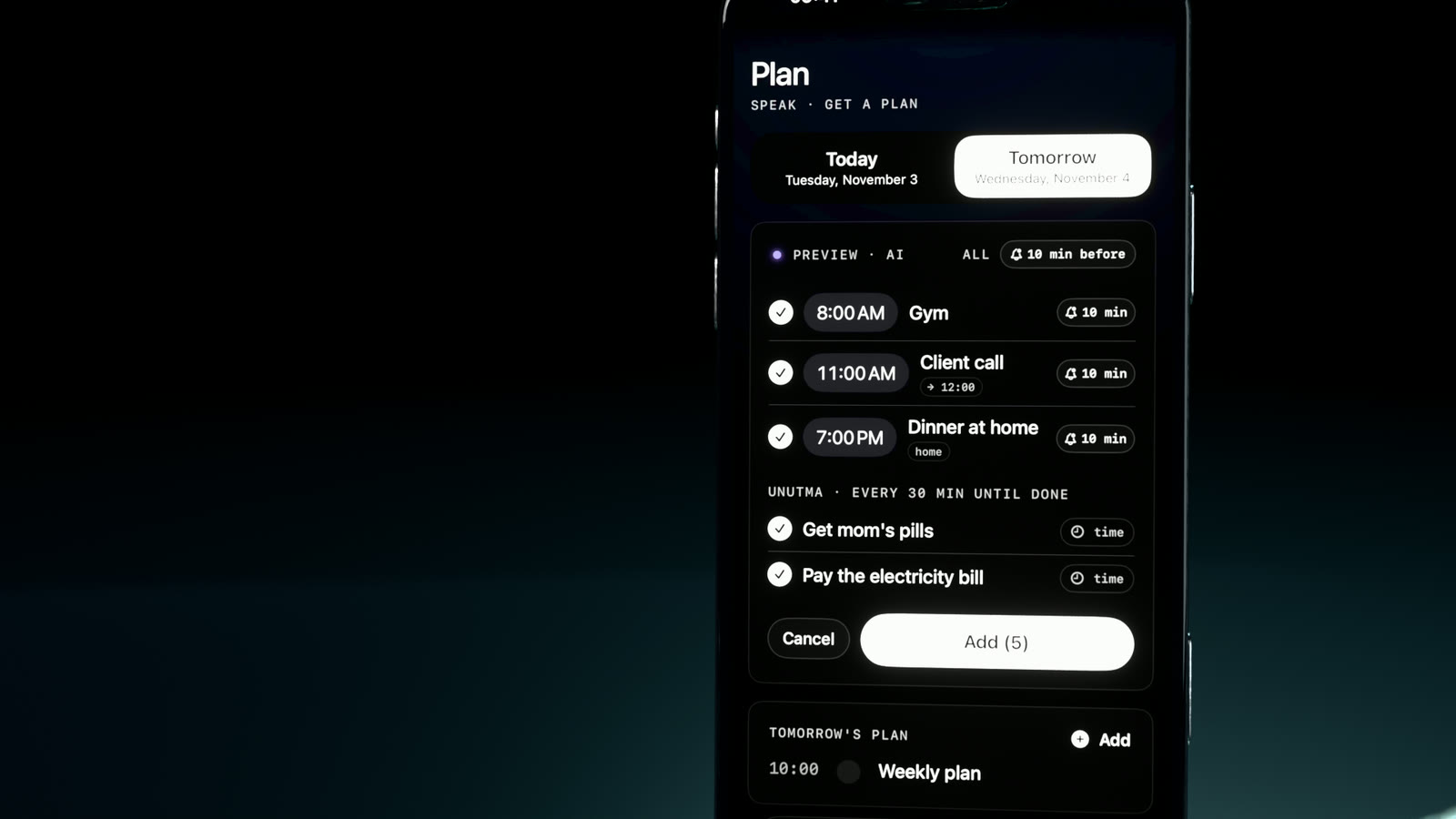
People plan in sentences: “gym at eight, a client call at eleven, pick up mom’s pills on the way home, be home by seven.” Planners make them type it into fields. Deyla takes the sentence — spoken, messy, in Turkish or English — and turns it into a day, with a model I trained for exactly that job.
Planning is easy. Keeping your word is the job.
The product bet is that the hard part of a plan isn’t making it — it’s the friction before and the follow-through after. So Deyla removes the typing at the start and refuses to let go at the end: unfinished things come back every half hour until they’re done, principles return through the day, and a stone grows with every day you keep.
That bet decided the architecture. If speaking is the main input, understanding speech can’t depend on an API key, a network or someone else’s pricing. So the language model is ours: trained, evaluated and shipped as part of the app.
02 — Our own model
Say it once. Our model turns it into a plan.
Apple’s Speech framework transcribes on the device. Then a planner model reads the transcript and returns the day as structured data — items, start and end times, “out” or “home”, what is a task and what is a reminder. It’s Qwen3 1.7B, 4-bit, with a LoRA adapter trained on Turkish and English days written to a labelling spec of its own.
It runs on the phone through MLX: a one-time download of the base model, the adapter inside the app, then no internet at all.
- Fine-tuned with mlx-lm on Apple silicon, versioned adapters
- A written labelling spec: when a bare “seven” means evening, what counts as “out”, how “till four” chains
- Training text corrupted like real dictation — numbers as words, dropped suffixes, fillers, no punctuation — with labels left intact
- A rule layer reconciles the model: if a time is twelve hours off, the rule wins
03 — Measured like code
A model is a dependency. It gets tests.
Each version is scored on six held-out sets — natural speech, times, places, long mixed days, short notes — the newest written blind, without ever seeing the training data. Every mistake is classified, so a new version is judged on what it fixes and what it breaks, not on one average. Training sentences that share too much with a test sentence are dropped before training.
When a real sentence from the app broke the model, it became a test of its own — and the pattern behind it, not the sentence, went into the training data, rewritten in other contexts.
- Six held-out sets plus real user failures as regression tests
- Error taxonomy per version: missing, extra, wrong time, wrong place
- Decontamination by word-trigram overlap with every test set
- Our 1.7B model: 89.2%; Claude Haiku with the same spec: 92.1%
04 — Three runtimes
Private by default. Better when you pay.
The planner has one contract and three places to run. Free users get our model on the device or on a small server; Pro swaps in Claude Haiku behind the same answer format, at about $0.0002 a plan and a second and a half. The app doesn’t know or care which one answered — so the model can improve on the server without an app update, and the business model is a switch, not a rewrite.
- Same request and response for all three
- Server model replaced by uploading an adapter, not shipping an app
- Cost per plan measured, not guessed
05 — Our own sound engine
Music made for this moment.
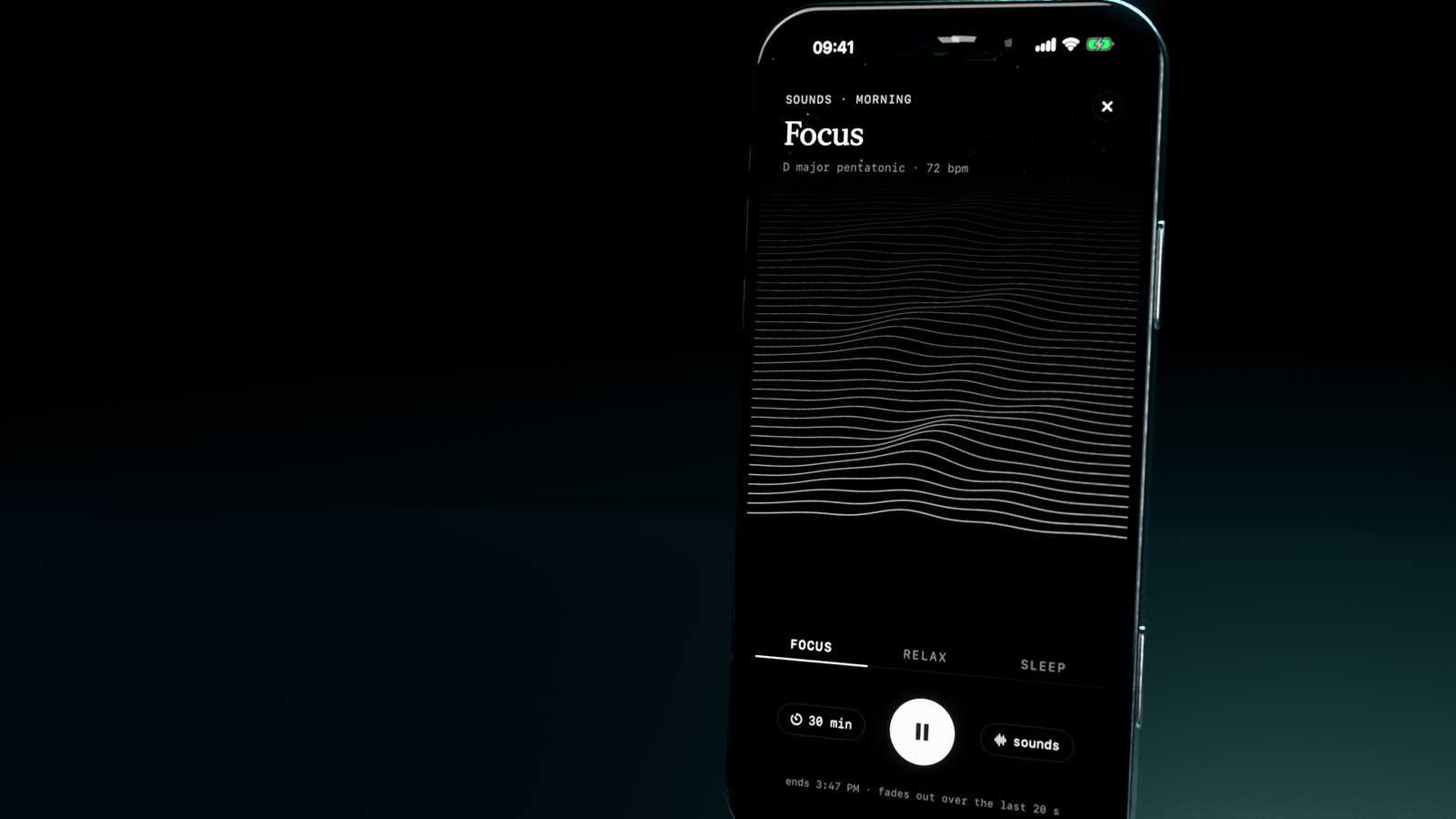
Focus, Relax and Sleep aren’t tracks; they’re composed on the device as they play. I wrote the synth from scratch on an AVAudioEngine source node — pads, bells, a pulse, bass, ocean and rain, binaural beats, a feedback-delay-network reverb — and it picks its key and tempo from the time of day. The line field on screen reads the engine’s live state and moves with every note.
- A DSP core with no UI code, shared by the app and an offline renderer
- The same engine rendered the site’s audio clips frame for frame
- Rebuilds itself on interruptions and headphone changes
- Timers fade out over the last seconds instead of cutting off
06 — Follow-through
It nags. Until it’s done.
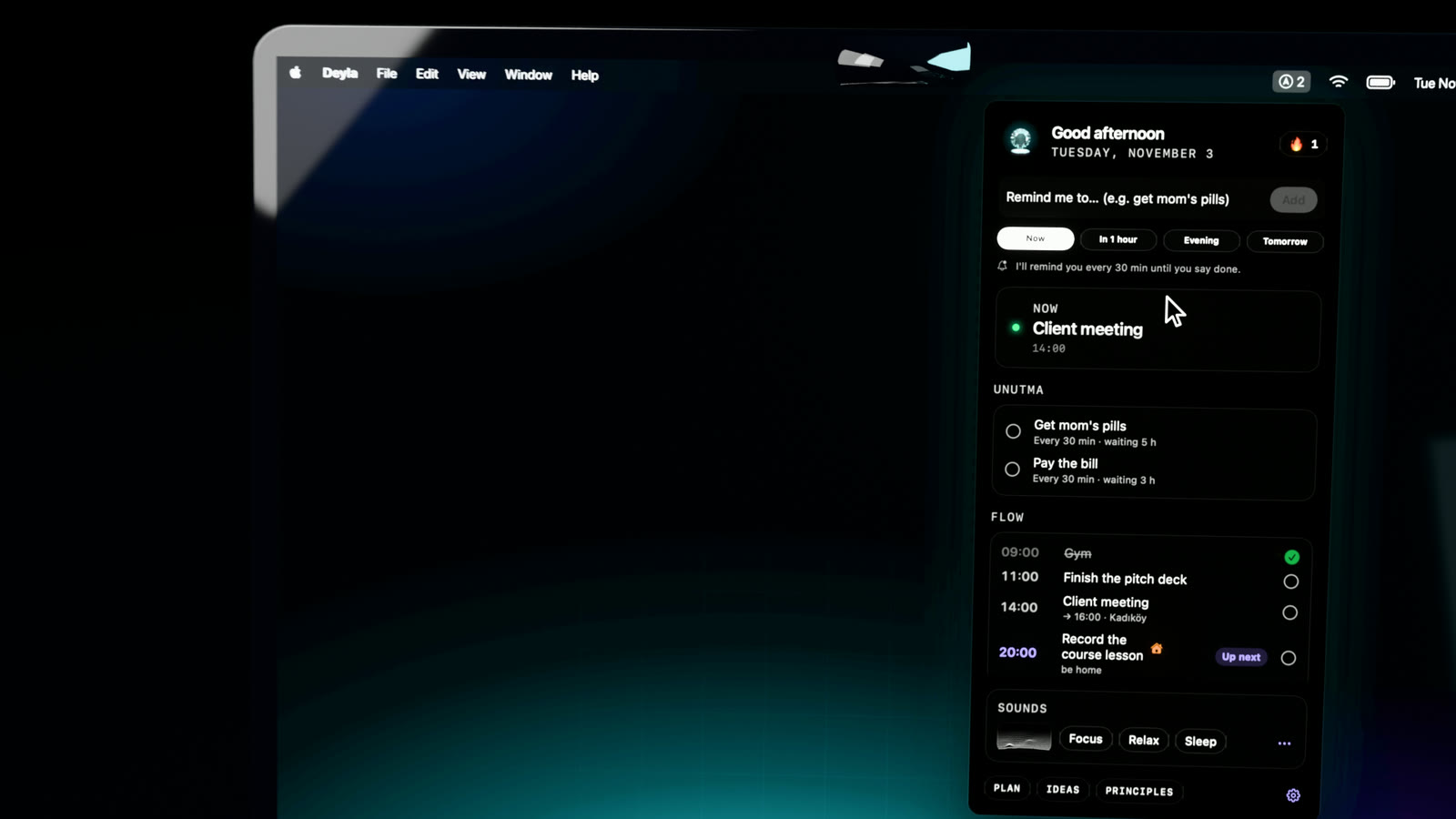
“Unutma” — Turkish for “don’t forget” — brings a thing back every thirty minutes until you tick it, on the phone and on the Mac, where Deyla lives in the menu bar: ⌃⌥N in any app, type it, pick when, back to work in two seconds. Around it, the tools that keep you honest: an alarm that won’t stop until the wake-up mission is done, and a lock on the apps that eat your evenings.
- Repeating notifications that stop the moment it’s ticked
- System alarms through AlarmKit
- Screen Time extensions: monitor, shield and shield actions
- “Be home” alerts from your saved home location
07 — Stones & brand
Keep a day. Grow a stone.
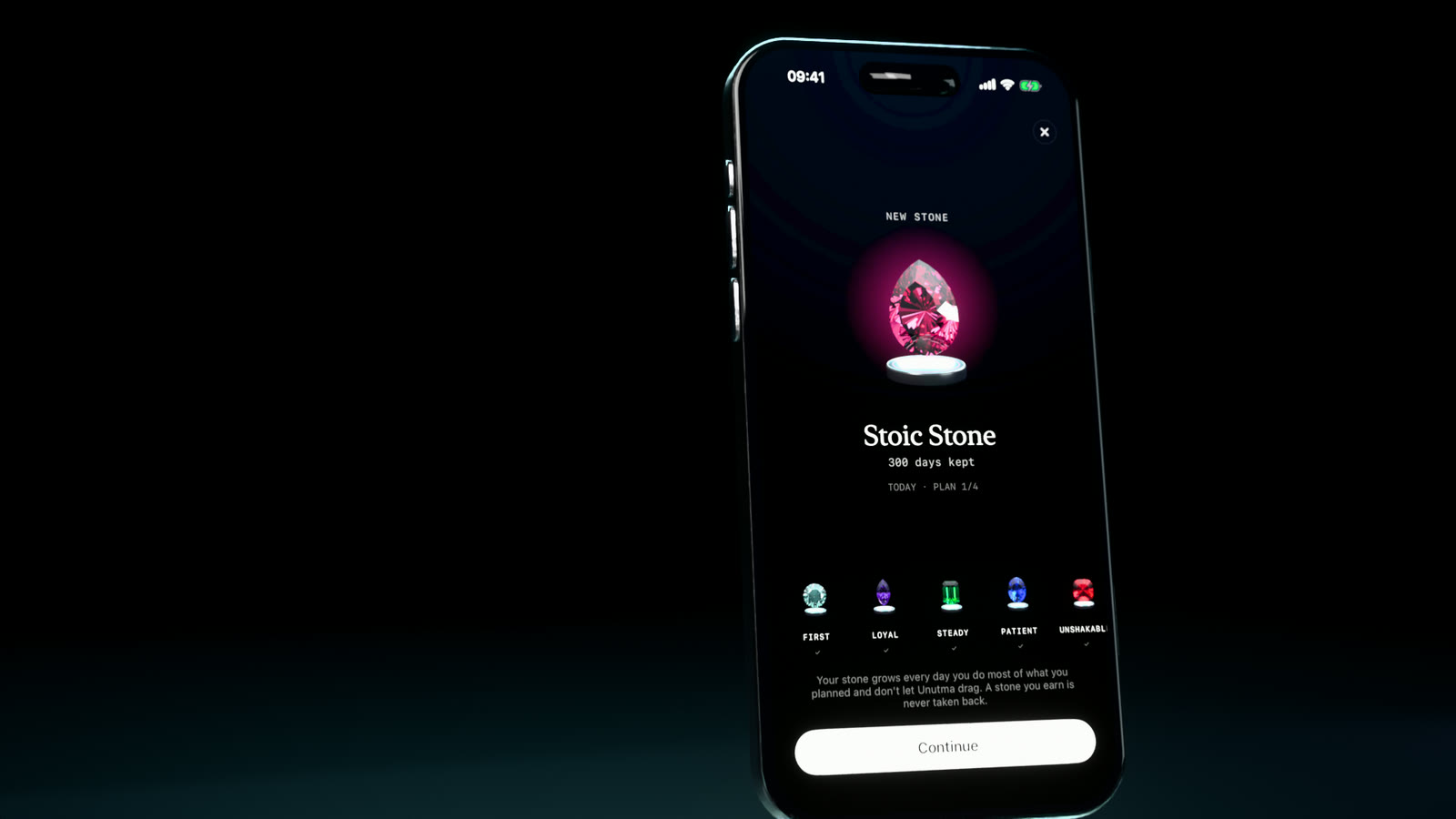
The days you keep add up to a stone that never goes back: a clear aqua diamond, then amethyst, emerald, sapphire, ruby, a canary diamond and a pink one. Each is cut, lit and rendered in Blender from a script, with real refraction and dispersion. The same diamond is the app icon, the hero of a three.js site that ray-traces it in the browser, and the film at the top of this page.
- Seven gems, seven cuts, so locked silhouettes tell apart
- One script-built art pipeline for app, icon, site and film
Stack
Model
- Qwen3 1.7B · 4-bit · LoRA
- mlx-lm training
- Own data, spec and eval suite
- MLX on device · Modal
- Claude Haiku (Pro)
Apps
- Swift · SwiftUI · Observation
- iPhone + Mac menu bar
- Apple Speech (on-device)
- App Intents · StoreKit
System
- AVAudioEngine · own DSP
- AlarmKit
- FamilyControls · ManagedSettings
- DeviceActivity · Core Location
Craft
- Blender · Cycles
- three.js (ray-traced diamond)
- Vercel
Outcome
Deyla is live on the App Store for iPhone and Mac: a talking planner with its own model, follow-through that doesn’t let go, music composed for the moment and a reward you can see — one native app with a menu-bar companion, and planning that works with no account and no connection.
Next, the planner model, its labelling spec and the eval suite go open source, so anyone building in Turkish or English can plan from speech on the device.
Speak your day. Keep your word.